
Category: Poem

  • To a Hijacker Who Left this Morning

    To a Hijacker Who Left this Morning

    When I lived in Alaska we would often roam the main concourse at Anchorage International Airport at night. You didn’t need a ticket for a flight or a reason to be there. We went because it was a place that you could walk around in in the dead of winter in your shirt sleeves. We also went because there was a decent restaurant that served the best Monte Cristo sandwiches I’d ever tasted.

    One evening, after devouring my Monte Cristo I was approached by a man maybe a little older than me. He asked my group about the need for a proper ID and something about an airline-issued half-fare card. I think the man might have been Dale Lavon Thomas who on the next day, and at gunpoint, hijacked a Wien Consolidated Airlines 737. He demanded to be flown to Havana. A flight attendant on her first solo trip persuaded the hijacker to return to Anchorage to let off the passengers. The plane then headed for Vancouver before flying on to Mexico City with a flight plan ending in Havana. Dale, sometime mid-flight, had decided he wanted a larger, long-range jet and returned to Vancouver where he was arrested by a Royal Canadian Mounted Police inspector.To a Hijacker who Left this Morning I I saw you I think, it was last night and alone your gentle voice, and soft, asked us, our friends, on the value of proper ID for the use of a borrowed but not possessed half-fare card and you were gentle but alone and perhaps I caught some energy from you. I don’t know what your business was so late at the airport and all you said was that you’ll have the bread by morning and could leave. And now I hear the plane has gone to Cuba and I know it was you, don’t ask me how but maybe your questions or maybe you and your gentle voice, and soft, gave you away, but I know. II Seems like things weren’t going your way seems like you don’t always get what you want seems like you’ll never get up and seems like it’s always over but mostly it never really began. Well, friend, I feel for you. —October 18, 1971
    To a Hijacker who Left this Morning
    
    I
    I saw you I think, 
    it was last night and alone 
    your gentle voice, and soft, 
    asked us, our friends, 
    on the value of proper ID
    for the use of a borrowed 
    but not possessed half-fare card
    and you were gentle but alone 
    and perhaps I caught some energy from you.
    
    I don’t know 
    what your business was 
    so late at the airport 
    and all you said was that 
    you’ll have the bread by morning 
    and could leave.
    
    And now I hear the plane 
    has gone to Cuba 
    and I know it was you, 
    don’t ask me how 
    but maybe your questions
    or maybe you and your gentle voice, and soft,
    gave you away, but I know.
    
    II
    Seems like 
    things weren’t going your way
    seems like 
    you don’t always get what you want
    seems like 
    you’ll never get up
    and seems like 
    it’s always over
    but mostly it never really began.
    
    Well, friend, I feel for you.
    
    —October 18, 1971
  • Timed Writing

    Timed Writing

    During my second trip to Bali in August 2007, I had the great fortune to work with Australian singer, comedian, writer and director of Writer’s Journey, Jan Cornall, during a creative writing workshop as part of the  Bali Institute for Global Renewal. Jan had us do a timed writing exercise as we sat around a common table under a pavilion beside a rice paddy. Next to us a farmer chased a monkey chasing ducks across a bund while an old man bathed naked in an irrigation ditch, thinking he was invisible. I recently rediscovered what I had scribbled down during that quick write.

    “Anything that turns up,
     just let it turn up.”
     Like the volume on the stereo
     or a guest at the door?
     Turn up, turn it up
     Wake up, wake it up;
     to night and day,
     to light and shade,
     to eager change.
     
     Hearsay’s distant storm
     forewarns,
     from someplace else 
     to where I am, 
     an approaching wreck to life and limb,
     that circulates among our kin.
     
     But out of sight is out of mind
     and brings a carefree
     separation 
     from what could have been 
     the weather’s fickle pilgrimage.
     
     Despite typhonic rumors wraith,
     adventure calls
     to an unknown place,
     a chance
     to release this somber state
     of what comes next 
     or what should be.
     
     Alone, not worried, sounds
     of life and ice in glasses rattle 
     while monkeys watch and wonder 
     what it is we’re doing.
     
     Quiet heads bent over pages, 
     writing words in random phrases;
     thoughts in stages
     at the center
     of this query.
     
     Souls and hearts or in between.
     “Two minutes to go.”  When
     was that said?  Two minutes to go,
     we’re at the end. 
     
     Ubud, Bali, 2007
  • Ubud Dogs

    Ubud Dogs

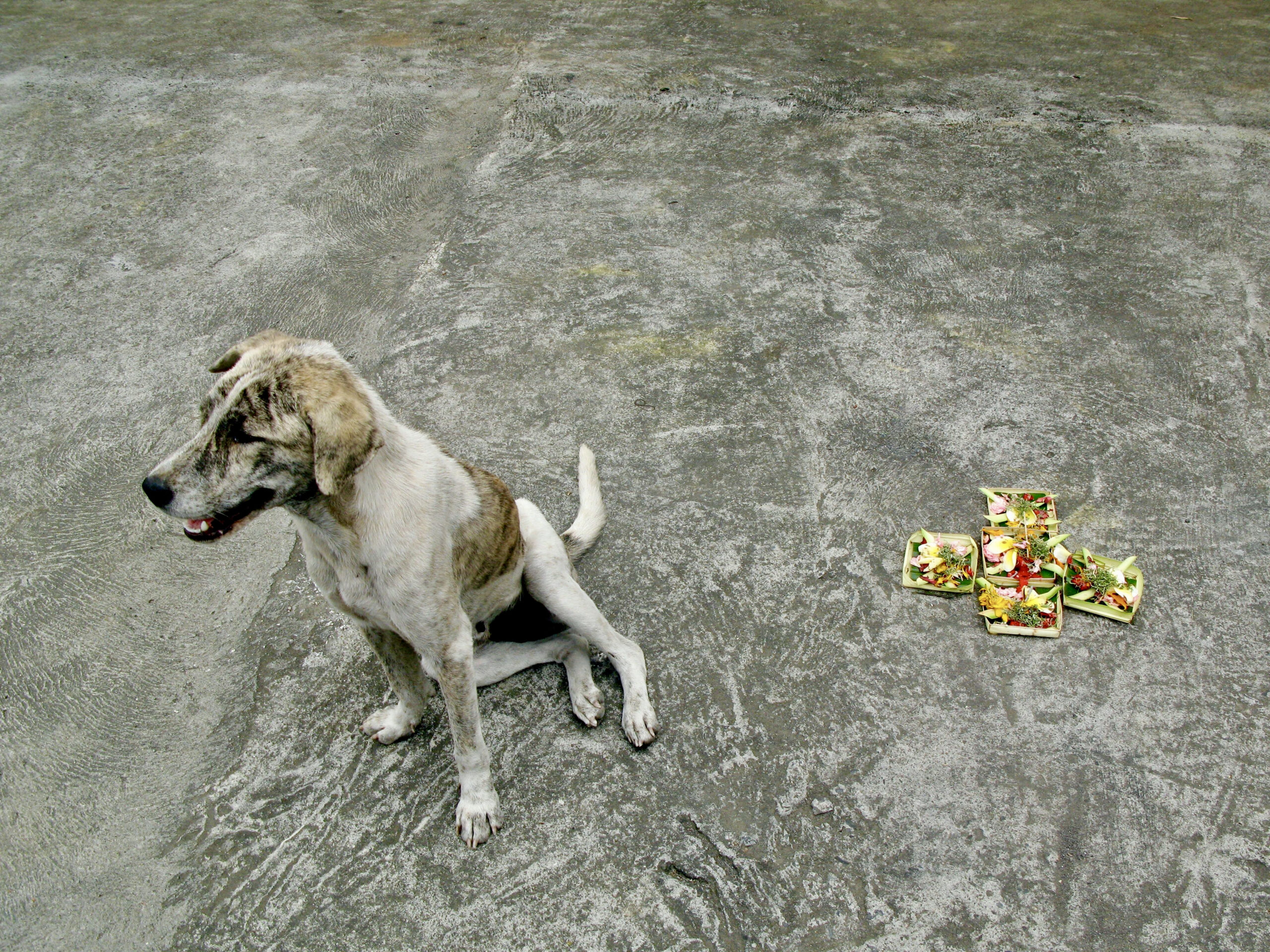
    I happened to be in Bali many years ago during Galungan, the celebration when spirits of deceased family members return to visit their earthly homes. I appreciated how the daily offerings in small palm leaf baskets, Canang Sari, were placed everywhere, on sidewalks and on top walls, on steps and in doorways, up high and down low. Those placed up high were for the benefit of good spirits, while those on the ground for evil—the hungry ghosts. In addition to the colorful flowers—frangipani, hibiscus and marigold—and incense sticks, these baskets also held rice, fruit and other morsels. I’d notice how the many stray dogs would devour the food left in the offerings at ground level, food meant for the spirits, in this case, the hungry ghosts.

    Ubud dogs roam streets
    in search of morseled offerings
    of rice and sweets
    and burning sticks
    and find delight, or so it seems,
    in scattered grains and ash and seeds,
    that one might think
    no need to feed
    these ill-bred dogs of Bali.
     
    With food for gods and spirits gone
    these canine beasts as hosts become
    a dwelling place, the sacred space,
    for hungry ghosts of Bali.
     
    From day to night these mongrels lure
    their parasitic spirit herd
    down streets that curve
    where traffic lurks.
    They’re barely missed,
    though some are nicked
    by cars and trucks, the motorists
    do try to dodge the roving dogs of Bali.
     
    The streetlights glare
    for drowsy mutts to settle down
    in fields, on roads or on the ground;
    but at the gate
    no master’s face,
    no whistle’s call,
    no beds await,
    no leashes tug to safely lead
    the homeless dogs of Bali.
     
    For a strangely blessed cur,
    in desperate heat,
    with matted fur,
    it’s understood
    there is no cure for
    the holy dogs of Bali.