Category: Book Excerpt

  • I’m Not Karl!

    I’m Not Karl!

    Here’s a sneak peak at a chapter, one that’s a bit eerie and quirky, from Hardship Alaska, my memoir coming soon from Epicenter Press about serving out my alternative service as a conscientious objector in the wilds of Alaska during the Vietnam War.

    I somehow fell into the company of an odd group of men. Their oddity only came to light when I found myself hanging with them in the basement apartment of a plump middle-aged man who resembled a character out of a Dickens’ novel, the kind you should most likely avoid; not like a Fagin, but more like a Bumble or Sowerberry. Housing in Anchorage was expensive and to find someplace cheap meant settling for shared, cramped and often dismal spaces, like this windowless basement room in someone’s private home. He wore a cape… all the time. When he pulled it closed around his tumescent middle you could see the sloppy spattered remnants of a recent meal’s bolus that had dribbled down the garment’s front. The stains reminded me of the food-soiled commoners or scholars gowns worn by Princeton students in a dining hall I stumbled into by accident one evening while wandering the campus in the late sixties. His two companions, now that I look back, were perhaps more concerning, in that they never seemed to question the Capeman’s ideas or actions. They reminded me of henchmen following their boss’s orders in carrying out some shady scheme.
    
    I must have met this crew a few months after arriving in Alaska when I was still working in emergency shelters and adolescent group homes for kids in crisis, my Selective Service alternative work assignment, before my time working with the people of St. Mary’s Episcopal Church in June 1971. I say this because, once I found myself involved with the church, my circle of friends seemed to improve. More than likely I came to know these men after attending a community theater performance, which they were either acting in or patrons of, maybe it was in January. They seemed to take an interest in me for some reason—I don’t remember if I was being flirtatious or merely looking lost—after the performance had ended and while attending a small meet-and-greet with the cast and crew. We were chatting about the Anchorage theater scene when the Capeman suggested we continue our conversation in a more private setting as the building we were in was about to close for the night. I followed them back to the Capeman’s apartment. I missed that part of my life and thought that becoming active in community theater again would be good for me, something to help remedy the long darkness of the Alaskan winter and the emotional stress I’d accumulate each day while working at one of the city’s emergency shelters or group homes. Maybe befriending these three would give me a better chance at joining the company. But once I got to the Capeman’s apartment, things turned weird.
    
    These three believed they were reincarnated friends and relatives of Beethoven and divinely brought together to finish writing his Tenth Symphony, a work that Beethoven had begun composing prior to his death but never completed. When they were talking to me about this project in the Capeman’s cluttered one-room, dungeon-like basement apartment, they mumbled something about the Curse of the Ninth. The long-forgotten rumor was most likely spread by Gustav Mahler about how a handful of Romantic era composers had died once they had finished writing a ninth symphony. Turns out it was all fabricated by Mahler. He was obsessed with the idea and even seemed to believe it. After he composed his eighth symphony and before starting his ninth, Mahler decided to write a symphonic-like work for two singers and orchestra, Das Lied von der Erde, thinking he’d be able to out smart the curse. The opus was to be a decoy to distract the curse. When it was completed, he then wrote his ninth symphony. He died anyway while composing his tenth.
    
    At any rate, the trio exposed their outrageous plot to me around a small wobbly coffee table surrounded by stacks of books, piles of classical records, discarded clothes and a random assortment of junk, all while sipping glasses of cheap sherry and nibbling on stale Ritz crackers. The Capeman said they’d been waiting for me to join them as the missing link they needed in order to realize a finished Beethoven’s Tenth Symphony. I had never met these three before, so found it unfathomable that they’d been waiting specifically for me. I think anyone that they would have encountered that night in the theater’s lobby, and who had the misfortune of following them home, would have heard the same tale. They thought I was the reincarnated spirit of Karl van Beethoven, the composer’s nephew, who Beethoven fought over in a contentious custody battle with his brother’s widow. I knew the story, having read the account in a Beethoven biography while a student at Westminster Choir College. 
    
    And although my mother occasionally talked about being reincarnated, I’m not sure I was ready to believe that line of thinking just yet. I do recall during my early twenties, however, of having a recurring dream, a nightmare really, of living in Vienna in the mid-1840s and waking up at the exact moment I was about to cross a street and be crushed to death by a quick-paced horse-drawn streetcar. But I didn’t think I was Karl in that dream. He died in 1851 from liver disease not from a tram accident. 
    
    With Karl supposedly residing in my body, the trio felt they’d have the power to reach out to the maestro himself, who would then feed the needed musical notes to the Capeman, or rather me as the musician in the room, from the great beyond, capturing fragments of leitmotifs in what sounded to me as an unlikely Ouija-like dictation process.
    
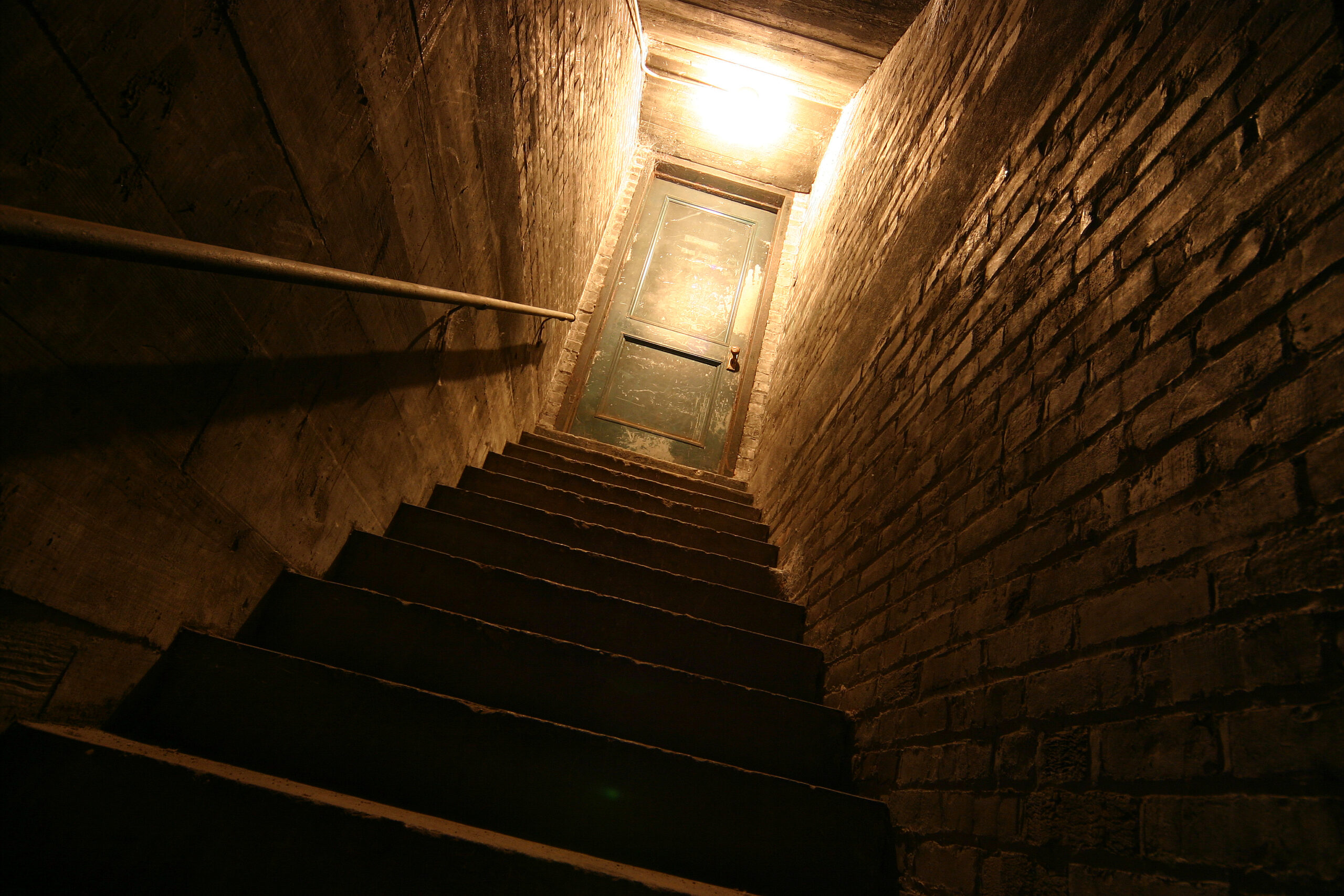
    One part of me, the small crazy part, was flattered, even though I wondered why Ludwig himself hadn’t opted to invade my body. The rest of me was scared out of my mind as I scanned the room for an exit, hoping desperately that the only door in the room was unlocked. I eyed the door with its concealed narrow staircase hiding behind it and waited for a lull in the conversation in order to make my escape. The lull arrived and I offered my thanks to the Capeman and his little friends for their hospitality and a no thanks to the offer of helping them, stating strongly, “I am not Karl!”, and bolted out the door, up the stairs and into the bleak midwinter’s night and freedom.
    
    As I drove back to my apartment, I heard my mother’s familiar warning about strangers in a strange land and how she worried that I’d be cannibalized when I least expected it. I considered finding an exorcist to cleanse my soul, but instead decided that maybe community theater wasn’t what I needed in my life right then.

  • Ditched

    Ditched

    On a flight from PHL to PWM, a bright March afternoon illuminates the view of the Jersey Shore through my private portal. I can pick out Lakehurst Naval Air Station, the large hangers once used for blimps and the site of Hindenburg’s fateful landing; Toms River, where I first felt at home as a music teacher; Bay Head and Point Pleasant to the Highlands and Sandy Hook. Images through an airplane window serve as a photo album of past experiences and memories threading through my life. New Jersey, the state I swore I would never live in, has been my home for nearly fifty years. I fly over Long Island with a quick glimpse to a shimmer of reflected light that is Manhattan, across the Sound to New England, my roots and wing toward coastal Maine, where tomorrow and the next day I’ll continue to serve teachers and students in their quest to make teaching and learning more meaningful, more connected to what matters in the world.

    This was just one of numerous flights crisscrossing the country and beyond I’ve completed since retiring as the principal of a public high school in central New Jersey and becoming a consultant in the arts and education. To get from one client to the next required, for the most part, flying: PHL to SFO or BIS or LAX or PWO, etc.

    I took the opportunity during those flights to capture, in written vignettes, the memories and events, places and people who had touched my life, for better or worse, during the span of two-years, 1970-1972, when I was a conscientious object during the Vietnam War. Each vignette was written in the time it took to fly from point A to point B. Once COVID-19 came along, my preferred writing spot, the drop-down tray table onboard a plane, had ceased to be an option to me. But the pandemic’s imposed isolation that we all went through, provided the time needed to craft the dozens of vignettes into chapters and subsequently, a completed memoir.

    So now I have a book, which could have only happened with the support of good friends and colleagues, my beta readers bunch, who read through early iterations of the work, participated in critique sessions, and continually offered helpful and specific feedback along the way. Thanks to each and every one of you: Herb Chamberlain, Mary Wagner LaFever, Dick LaFever, Kristyn Kamps, Joan Duff-Bohrer, Holly Anna Jones, Ryan Sprott, and Lois Josephs. And one of the smartest things I did was to work with an editor this past year, Cullen Thomas. I’ve learned so much from him and have benefitted from his support and mentoring in ways I could never have imagined.

    My next challenge is to publish, whether independently or with the help of a literary agent. I’ll keep you posted on my progress.

    Meanwhile I’ll share a brief excerpt from the book. This takes place in the middle of a road trip to Alaska on my way to begin my two years of alternative service as a conscientious objector. As I’m crossing the Saskatchewan prairie my car is blown off the road and into a drainage trench by an unexpected gale.


    Ditched

    The next morning, I rose early again and dragged my duffle back into the Volkswagen. I forgot to physically check out of the Holiday Inn even though they had taken an imprint of my credit card, well, my dad’s card really, the night before. I guess I had done that in Moorhead and Chicago, because when I called home later that day once I got to Edmonton, my father, not using his “gee, son, it’s good to hear your voice” tone, let me know he was annoyed having to accept collect calls from hotels to approve the charges for my one-night stays.

    Once on the road I found another radio station with excellent programming. This one touched on all my favorite musical styles and genres. I heard a piece by the late Romantic German composer, Richard Strauss, followed by a folk song, followed by an orchestral piece conducted by Benjamin Britten, a real favorite of mine, followed by the Rolling Stones. I was zipping along the highway in a great mood, the music, at least for the moment, taking my mind off feeling lonely and thinking about the next two years of my life serving as a conscientious objector.

    Somewhere between Regina and Edmonton on a desolate stretch of prairie highway the wind screamed. I drove headlong into a fierce flash storm, a snow squall really, that took the horizon and shadows with it, leaving only white. Losing control, I crossed lanes into oncoming traffic, my car blown into a ditch on the other side of the road. And then it was over. Clambering out of the car, I could see that I was not the only one who had been caught by surprise—a half dozen cars, guttered and spun in opposite directions lay all around me.

    Getting back into the car, I attempted to drive out of the ditch and up onto the highway, but the car was wedged tightly against the incline sides of the drainage gully, unable to move forward or backward. Leaving the car, locking the door, I stood by the side of the road looking for something hopeful. I noticed what could be a small town, buildings at a crossroads to the west, in the direction I was headed. Crossing back to the other side of the road, I began hitchhiking toward the structures. Recalling my mother’s warning before I left home not to pick up hitchhikers or ever hitchhike for fear of being eaten by cannibals. She was referring to a recent report of a young man in Colorado or some other western state, having been devoured by a stranger he picked up on the side of the road. I stuck out my thumb.

    An old rust-blemished blue pickup truck with a man and his son slowed as they approached the scene, not to offer me the kindness of a ride, but rather to take stock of the debris scattered along the highway. I had been ignored in my time of need and I wasn’t having it. As the truck passed, I leaped onto the rubber tread of the running board, gripping the door handle for balance and entry. Wrenching it open, I slid onto the seat shoving the boy against his father’s side, both startled with the unexpected intrusion.

    “Sorry, sorry, sorry. You’ve got to help me. I just got blown off the road, my car is now on the other side stuck in that ditch.” I pointed to the drainage trench running alongside the road. “I’m not from here.” I think they realized that fact. I was frantic and panicking. “Please, I’ve got to get to the nearest gas station and find someone with a tow truck.”

    Rather than being bounced to the curb, the man cautiously obliged, his sense of responsibility and compassion winning out while the boy stared straight ahead and said nothing.

    “I’ll help. There’s a garage a bit further up the road, But you got to know how you scared the both of us.”

    I sat back against the sagging bench seat, feeling every spring beneath the ripped and ratty vinyl, my left side pressed hard against the boy in the cramped cab. I exhaled a breath that felt like I had been holding since being thrown off the road. The boy seemed to relax as I began to breathe normally. I looked over at the two of them finally realizing what I had done.

    “I’m sorry. That’s not like me to do what I just did to you.”

    He took me to the next intersection, a crossroads with two tall grain silos and a working garage. He dropped me off at the side of the road and by the time I turned to thank him, he had already taken off, kicking up slush and small stones in his wake.