Category: Book Excerpt

  • The Archive and the Body

    The Archive and the Body

    This excerpt is from my new braided memoir–historical fiction novella, A Name Unbroken: The Archive and the Body, which will be published in 2026. The work shifts between the court records of the Salem witch trials and moments from my own life, illustrating how accusation, silence, and survival leave their marks over centuries. Before I even entered the archive of Susannah Martin, I had learned how easily a life can be misunderstood, how the body holds what the record leaves out, and how long it can take to reclaim one’s name. “The Archive and the Body” stands alone as a reflection on those early lessons.

    The Archive and the Body

    I did not know
    a name could tremble
    until mine did.

    December 1969—
    a cold lodged in the teeth
    of every windowpane.
    In the boarding-school dormitory—
    a white-brick mansion
    never meant to house us—
    I locked my door at night
    for the first time,
    hearing boys breathing
    down the hall,
    the radiator ticking beside me—
    a second heart
    I could not steady.

    Rumor moved quicker
    than breath.

    Something worse,
    passed behind cupped hands,
    a phrase in accented English
    that cracked my ribs open
    where I sat:
    Pied Piper to leetle boys.

    Accusation
    is a bitter wind
    that finds its entry
    even when the house
    is sealed.

    The headmaster
    called me son—
    official, practiced,
    not my name,
    a word borrowed
    from another man’s house.
    He wanted truth.
    He wanted confession.
    He wanted to mend
    what he believed was breaking.

    But I had already learned
    the quiet terror
    of being seen
    incorrectly—
    how a single glance
    can warp into suspicion,
    how silence
    becomes evidence
    against the one
    whose name has begun
    to tremble.

    My closest friend vanished.
    My accuser vanished.
    The story folded itself
    into another wind—
    retracted,
    discredited,
    claimed by no tongue
    that carried it.

    I walked the campus
    as the newly visible—
    a silhouette carved
    from rumor,
    stitched back
    with caution,
    wary of every corridor
    that once felt familiar.

    Years later,
    after the snow of that winter
    had been buried,
    I learned a truth
    my younger self
    could not imagine:
    on a bus returning
    from Lincoln Center,
    the boy I believed
    had abandoned me
    took another’s face
    in his hands—
    the boy who once whispered
    the stories that weakened
    my name—
    and slammed loyalty into him
    with a suddenness
    like judgment breaking open.

    He fought
    with a fury
    I would never claim,
    broke a tooth
    for my name,
    took back the rumor
    by force
    when I could not
    shape a single word.

    But I did not know.
    Not then.
    Not when it mattered.
    The loneliness was real
    even if the loyalty
    was too.

    This contradiction
    became my first archive:
    the locked door,
    the whisper,
    the weight loss
    read as omen,
    the friend who vanished,
    the friend who had not,
    the bruise held quietly
    in another boy’s jaw
    because he had spoken
    my trembling name
    with contempt.

    I had survived
    my first trial
    without knowing
    I was on trial.

    And something in me tightened
    that winter—
    a thread pulled
    too hard,
    too long.

    The body remembers
    what the world forgets.
    Shame stores itself
    like a keepsake
    we never meant to save.

    Every story begins
    with the wound
    we do not name
    until it is echoed
    in another.

    Joseph’s frostbitten fear
    would find me later.
    Susannah’s defiance,
    later still.

    But this—
    this was the first tremor,
    the first whisper teaching me
    how a life can be misread
    in a single season,
    and how long it takes
    to lift a name back
    from another’s grasp
    and learn to speak it
    as your own.


  • First Communion

    First Communion

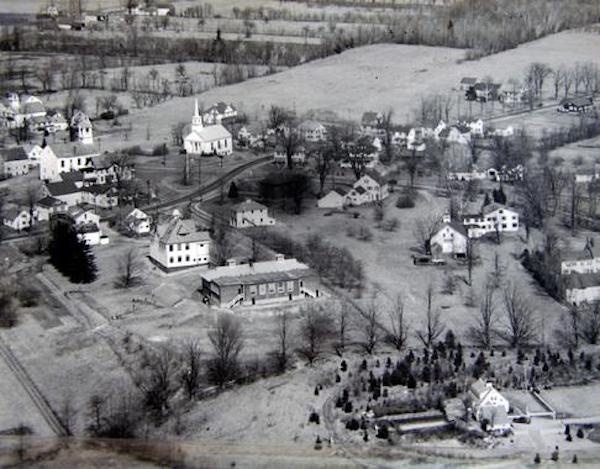
    My parents had me christened in the Congregational Church across from town hall on the edge of the village commons in the town of Lunenburg, Massachusetts. The church was where I performed in my first piano recital in the fellowship hall below the sanctuary. I probably played something out of John Thompson’s Modern Piano Course or maybe it was something even more fundamental from his Easiest Piano Course, the books with the illustrated goblins pointing out clefs and time signatures, notes and rests. It was where I celebrated my first communion. The no-frills sacrament wasn’t a special affair. I didn’t have to wear a new suit bought expressly for the occasion and I didn’t receive a certificate stating that I had crossed some spiritual milestone. It was probably just an accident of fate, not faith, that caused me to be there on that Sunday morning.

    As a child I attended an austere Congregational church with my grandmother in Lunenburg. Grammy somehow thought I was a holy child and got me a monthly subscription to an Oral Roberts’ magazine for children. Roberts, a Choctaw televangelist, had a worldwide following and was known for his ability to perform healing miracles; he himself having been healed of a severe stutter and tuberculosis when he was seventeen. 
    
    On one Sunday, I must have been around six years old, she took me to my first Wonder Bread and Welch’s grape juice communion, an event that only happened four times a year at this local church, most Sundays intended for preaching the Word. The bread was served on silver-plated platters passed down each pew where every person took a piece and held it patiently in their palms until everyone in the congregation received theirs. The grape juice followed in a similar serving tray but one equipped with slots to hold tiny individual cups filled with the purple liquid.  Once everyone was served, and as if on cue, the entire congregation popped the small squares of spongy bread in their mouths, chewed and swallowed and then drank the juice from the tiny glass cups in unison; like men at some corner tavern nibbling on bar nuts then in unison downing shots of bourbon that had been lined up and waiting along the bar top. When everyone had finished, the tiny glasses were inserted in drilled out holes in a small wooden shelf screwed to the back of the pew in front of them. I joined the others in drinking the juice, but forewent eating the cubed piece of bread, instead squeezing it in my small fist, holding it there until the service ended. Once outside, I tossed the now pulpy lump behind a shrub near the steps of the church. I was afraid that if I ate it, Jesus would pop out of my mouth on the ride home in my grandmother’s black ’48 Chevrolet Fleetline. To this day I still think about that piece of bread every time I pass the church on my way to North Cemetery to visit the family plot or attend a relative’s funeral. 

    Photo: Lunenburg Historical Society

  • Planet of the Apes

    Planet of the Apes

    Evening entertainment in an Alaskan Arctic village during the summer of 1972 was scarce; I usually played my guitar or read. So, when the mail plane dropped off a feature film, even though it had been released four years earlier in the Lower Forty-eight, I made sure I got myself to the old Quonset hut that served as the village’s common meeting place and cinema. Here’s a chapter from my upcoming memoir, Hardship Alaska, from Epicenter Press.

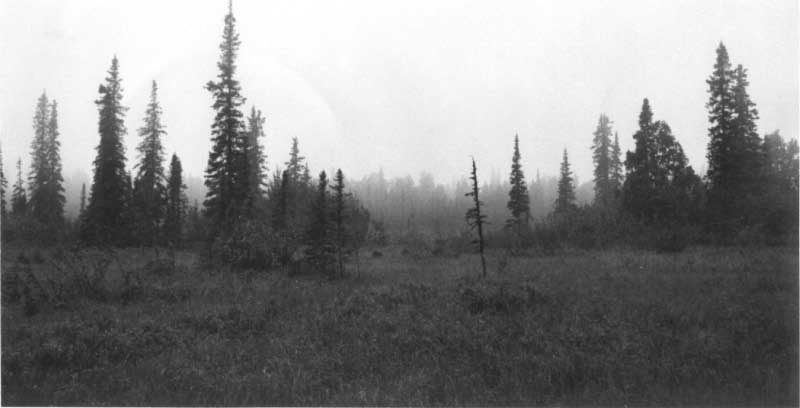
    Now I stood where time had no meaning, where the sun circled my days and nights, never quite dipping into the sea. I'd leave my room each morning with my guitar slung over my shoulder and cut across the short distance to St. Thomas, the small Episcopal mission on the northern edge of the village. 
    
    There was a one-sentence blurb in the church's one-page bulletin the Sunday prior to my arrival announcing my purpose for being in the village. There was no further communication about it after that, and, I would learn, no need for posting choir rehearsal or music workshop days and times. I wondered how I would attract followers without additional advertising.
    
    "Fifteen minutes before you're ready to begin," said Donald Oktalik, the village patriarch and the St. Thomas's ordained priest, "ring the church bell and see who shows up. They know you're here and want to work with you."
    
    "Just like that?”
    
    "Have faith," was all he said and went back to carving a replacement part out of whale bone for his snowmobile.
    
    I didn't have faith. I was a doubting Thomas working in a remote Arctic church named after the very same questioning apostle. Nevertheless, ringing the bell worked. And yet, the cause and effect, ring the bell and they will come, did little to bolster my faith that it would happen any time I rang that bell. At any rate, people showed up for these sessions—choir rehearsals, guitar lessons and practice with anyone even minimally interested in playing hymns for services on the temperamental electric organ.
    
    So, I'd pull the rope that rang the bell outside the church door that brought the people that became my students. I also played the weekly church service, and on my last Sunday in Point Hope we performed the folk mass I composed for St. Mary's. On another Sunday when the power had failed, I pulled out the old asthmatic missionary organ, a simple reed instrument with a shortened keyboard and bellows covered in seal skin, the original leather long since worn out and discarded. The power exerted by the bellows was no match for the single rank of tired reeds and no matter how hard I pumped on its hanging pedals, the organ could only wheeze out a barely sustainable tone. Adding chords to the melody compounded the struggle, causing the poor thing to gasp for its next breath of air each time I pumped the bellows. In a demonstration of sincere empathy, the congregation adjusted their singing out of an unexpected sense of compassion and respect for the ailing instrument.
    
    The community went out of its way to make me feel a part of the village, inviting me for suppers of cold canned vegetables and muktuk pulled out of sigulaks, square holes dug down into the permafrost which served as ice cellars. Many houses had personal sigulaks where families stored provisions, but there were larger ones, too. Each whaling crew dug deeper vertical shafts accessible by ladders and fortified with wood planks and posts that led below the tundra and provided additional storage space for large amounts of whale meat caught during the hunt. I was told that the spirits of the caught whales also resided in the sigulaks along with the meat, adding a sacred purpose to the space.
    
    The meals I consumed seemed to consist of a combination of metallic mush and rancid blubber. I learned quickly to tilt my head back while chewing the sticks of blubber so that the whale oil could find a path to my stomach while avoiding my taste buds. I may have made a big deal about it at first, using humor to deflect my early discomfort with this new taste experience, but soon I found myself eating and smiling and grateful for being part of their world and having something to eat. Meals became a daily eucharist, sacred and celebratory as we gave thanks to the sacrificed whale whose flesh sustained us.
    
    That night I walked along gravel paths in one of the oldest continually inhabited settlements in North America, passing the corrugated metal clad post office, 99766, and parked dog sleds attached to snowmobiles. I soon arrived at the World War II-era Quonset hut which now served as Point Hope's one and only movie theatre. A screen mounted on one wall faced off against rows of backless benches which, after the first few rows, grew incrementally higher on stilt-like legs. A wobbly balcony offered an unobstructed view to the screen. Weakly anchored to the floor but not to each other, the bleachers seemed to float under the half-moon arc of the structure's corrugated roof. Maintaining balance, particularly at the higher levels, was a team effort. One unexpected movement from any one bench mate could topple the entire colony. A 16 mm projector balanced uneasily on a metal shelf bolted to the back wall. To start, stop or change reels required the use of a stepladder. A single cable slid down the wall beneath the projector and across the floor making its way to a single speaker below the screen. Films were delivered at will from some unknown distributor or library in Nome or Fairbanks on the plane that carried the mail. 
    
    The audience arrived with that certain excitement of a night out with friends who haven't seen each other in some time, even though most of them had spent the entire day together. Someone offered me a hand and I was hoisted up onto one of the medium height bleachers. I immediately surrendered to the group's sense of balance as my legs dangled freely below. The simple gesture, a hand reaching out to welcome me, to be raised up, to join these intimate strangers for a couple of hours of Hollywood diversion meant everything to me at that moment. I had never been so far from home and in need of feeling connected, of being accepted. And yet here I was, at the end of the world, finding that connection, that acceptance. As our row engaged in a perpetual game of give and take in order to maintain balance, we began to know and trust our places on the bench. We seemed to breathe together, adapting to each other’s movements, protecting the whole lest one of us forgets where he was, and we all come tumbling down.
    
    The windowless Quonset provided the perfect remedy to the midnight sun outside. Someone climbed the ladder with this evening’s presentation and threaded the first reel of film through the projector. As the film wound its way through the sprockets, the operator motioned for someone in the audience to switch off the lights. Darkness gave way to the film leader’s dyslectic numeric countdown, 10, 9, 8, 7, 6, 5, 4… fade to black and then the single monophonic speaker crackled out a snare drum cadence and brass fanfare as searchlights scanned an iconic art deco monument to Twentieth Century Fox, Charlton Heston in Planet of the Apes. I struggled to hear any dialogue or follow the plot due to the increasing laughter from the audience, who seem to be finding this epic one of the funniest comedies they had seen. There came a point where I was laughing, too, not quite understanding what made the film so funny to them, yet somehow caught in a paroxysm of giggles.
  • Open Door Klinic

    Open Door Klinic

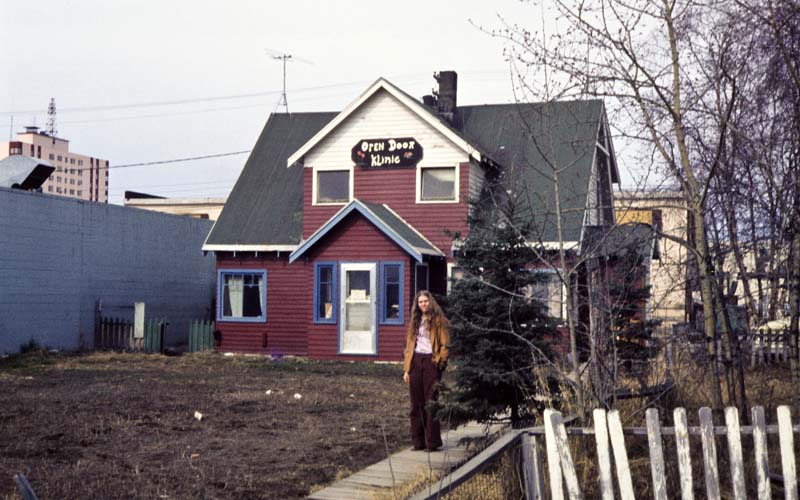
    In my prior post I featured the late photographer Stephen Cysewski and the influence his images of Alaska in the 1970s had on my writing. His photo of the Open Door Klinic at the top of this post became the memory trigger for this excerpt from Hardship Alaska.

    Here I’m recalling the second of two incidents when someone had tried to show me affection at a time when I was trying to keep my sexual orientation a secret. His gesture, I’d like to believe, had my best interest at heart. It was as if James Baldwin was whispering in my ear about the folly in trying to conceal a major part of myself from others by living a supposedly secret life. There was no secret being kept that others couldn’t already see through. The people around me had already figured it out or didn’t care. They had already accepted me just as I was.

    The second incident lasted only a few seconds but seemed to carry a deeper level of caring than going to a bar for drinks. Jamie Love, a great guy who reminded me of Arlo Guthrie, established a place called the Open Door Klinic in a house in downtown Anchorage. It targeted young people who flocked to Anchorage in the summer from the Lower 48 or outside as he called it, in need of housing. The Klinic also provided narcotic addiction counseling for those who needed it, and it was a safe place where some of my group home kids would hang out after school. It was also a place that I’d visit from time to time. I liked the atmosphere, upbeat and positive with a great group of people who lived there, communally sharing the house. I also liked how everyone pitched in to manage the day-to-day tasks of cleaning, cooking and supporting each other. Sometimes when I visited, I’d bring over a few of my albums to share—Jesus Christ Superstar, Missa Luba, Hair! and the Beatles’ White Album. 
    
    On this occasion, however, I had probably stopped by the collective to follow up on one of the kids at the boys group home. Sometimes kids would end up at the commune seeking safe harbor with Jamie while trying to sort out their lives. Jamie seemed to know when someone who stumbled into his operation was not quite ready for this kind of freestyle communal living; someone who might need to be somewhere else, someplace safer and with more structure. When Jamie referred someone to us at Alaska Children’s Services, we’d follow up with him to let him know how his referral was coping in a new setting. If it was a boy he referred and I was involved, the kid would most likely have ended up with Alice Aiken and her charges at the boys group home where I also worked as a relief counselor. Most kids made smooth transitions, in some cases from being nearly homeless after a family crisis to finding a caring and stable place to call home. 
    
    After following up with Jamie, I stopped by the kitchen to discover a guy about my age, in his early twenties, boiling water for tea. He introduced himself to me, another name I’ve misplaced, and asked if I wanted a cup of tea, which I happily accepted. Sitting at the kitchen table, we engaged in small talk, nothing too personal, probably just about the weather, until he asked about where I was from and what I was doing in Anchorage. I filled him in on all of that and in a stalling moment in the conversation, he reached over and gently touched my cheek. It was such a warm and caring gesture that I let his soft touch linger until I heard the silence in the room and jolted back from his caress to reclaim the conversation. I thought that maybe he saw something in my eyes that provoked him to reach out at that moment. Maybe, I thought, he saw a part of me I wasn’t ready to reveal just then. Or he saw a part of me he was comfortable with. The moment may have passed in seconds, but that touch, an overwhelming tenderness, has somehow stayed with me forever. There was nothing sexual about it, just the touch from another human. I could have leaned over the table for a hug but didn’t, leaving the encounter like an unfinished sentence.
    
    
  • Thanksgiving

    Thanksgiving

    My upcoming memoir from Epicenter Press, Hardship Alaska, chronicles the events, people and places immediately leading up to and during my time serving as a Vietnam War era conscientious objector. The heart of the story focuses on my two years of alternative civilian service working in and around Anchorage Alaska. My assigned duty initially had me working in emergency shelters, group homes and residential treatment centers for kids in crisis. I arrived at Anchorage Children’s Christian Home on Halloween night, 1970. Even though I was surrounded by the children in my care and the adults I worked with, my feelings of isolation and loneliness took center stage, especially as my first Thanksgiving away from home neared. I wrote Herb Chamberlain, my former college roommate, about the upcoming holidays and how much I feared being alone at that time of the year. But to my surprise, I discovered the opposite. Here’s an excerpt from the book about that first Thanksgiving away from home.

    Photo credit: Stephen Cysewski

    I wrote Herbie on Wednesday, November 25, 1970, just a few weeks into my alternative service assignment that, “Thanksgiving will be hard away from home… But, Christmas will be the worse of the two—I will be working. I do not wish to be alone. I may even spend the night at the receiving home. Oh, well, there are better things to think about other than loneliness.”
    
    The next day, which I assumed would be less than a special holiday away from my family turned out to be one of the best Thanksgivings ever.
    
    A group of us from Alaska Children’s Services were invited to spend the day at one of the administrator’s homes. We had staff and kids from a couple of the group homes, many of us away from our families both here in Alaska and the Lower 48. And for more than a few of us, it was not our choice.  We went ice skating from midmorning to around three that afternoon. The house backed onto a large lake, and now that it had completely frozen over, it became an extension of the backyard. It was a large gathering with the administrator’s family, his neighbors and the rest of us.
    
    We stopped a couple times for hot chocolate and to warm up a bit. On one break someone had put on the 1959 recording of Beethoven’s Ninth Symphony conducted by Bruno Walter with the Columbia Symphony Orchestra and Westminster Symphonic Choir. A great recording, which sent me into reveries of being back East, Westminster Choir College and home. The Ninth was a particular favorite of mine ever since last spring when we performed it with Leopold Stokowski and the American Symphony at Carnegie Hall.
    
    While skating I met an 8-year-old neighbor’s kid who asked if I wanted to take a ride with him on his snow machine. There were a few snow machines idling at the shore along with motorcycles that would regularly scoot off with their riders laughing and whooping across the frozen surface of the lake. The ride was exhilarating, and I marveled at my young chauffeur’s skill at handling the machine.  It was a great ride and when we returned to the house, I thanked my diminutive driver and told him how much fun I had riding with him.
    
    At 4:00 we went inside, tossing our winter gear in a guest bedroom, and joined the family for their Thanksgiving feast. There were so many of us that the meal needed to be served buffet style. We’d never fit around our host’s dining table. We grabbed plates, silverware and napkins and loaded our plates with strips of Alaskan salmon candy, slices of roast caribou, reindeer sausage and foods I was more familiar with back home—turkey, sweet potatoes and the rest.
    
    After the meal, we said our goodbyes and headed back to the girls group home to play board games and then went tobogganing until after 10:00 p.m. The whole day was great fun and I was deeply thankful to have been included in this wonderful celebration.
    
    Riding on my Thanksgiving high, the next morning I went off with Lucille, the lead counselor at the girls group home, and we each bought a pair of cross country skis, poles, boots and wax to keep the base of the skis slick. The winter in Alaska would not keep me trapped inside under an electric blanket. I was going to make the most of the next two years.