The city’s black steel and concrete-gray buildings sparkled in the rain, their dark hues vibrant; even the dirt and trash-filled gutters glistened as if wrapped in a high-gloss clear coating. Nearly blinded by this dazzling display, I thought I heard an angel speak, her voice cutting through the light. I couldn’t make her out as she sheltered in a doorway to keep dry. I was flattered that I had captured someone’s attention, even for the wrong reason. The rain tapered off as she stepped out from the doorway and began hovering before me like Botticelli’s Venus, only with more makeup. Steam from the sidewalk and street rose around her.
“Hey, you want a blow job?”
“No thanks!”
“Aw, come on, honey.”
“Nope! I have to catch a train, and besides….”
And then, as if she could see me for who I was on the inside, she dropped her pitch.
“Oh, I get it. I’m not your type, or are you into boys? That’s OK, sweetie; enjoy your train ride.” She scurried back into the doorway shelter, dodging inconvenient puddles and shouting to the sky, “This is why we don’t do outside.”
I hurried toward Penn Station and hopped aboard the Jersey Coast Line to Bay Head for much-needed rest.
I took the train into Manhattan a lot that August, sometimes the bus, and sometimes I drove, parking at the Port Authority Bus Terminal. I’d answered an ad in the Village Voice buried deep in the personals and whatnot at the back of the paper. The ad was an open call for pianists interested in becoming dance accompanists—a one-week class that, once it began, turned into three with the promise of regular work after completion.
I answered the call and got accepted. I found my way to 316 East 63rd Street—Martha Graham Center of Contemporary Dance—a week later.
I had arrived at Graham’s school and studio following nearly a decade of artistic, financial, and leadership struggles. Graham herself had lost total control of the company and its direction by the late Sixties when it became necessary to establish a nonprofit foundation to survive. Her presence on stage as a dancer was over due to ailments and age. Her company no longer resembled the one she knew and had built over the years. Some former members had moved on to start their own troupes (Cunningham, Hawkins, Sokolow, and Taylor, among others), requiring the company to recruit and train new dancers.
The city’s black steel and concrete-gray buildings sparkled in the rain, their dark hues vibrant; even the dirt and trash-filled gutters glistened as if wrapped in a high-gloss clear coating. Nearly blinded by this dazzling display, I thought I heard an angel speak, her voice cutting through the light. I couldn’t make her out as she sheltered in a doorway to keep dry. I was flattered that I had captured someone’s attention, even for the wrong reason. The rain tapered off as she stepped out from the doorway and began hovering before me like Botticelli’s Venus, only with more makeup. Steam from the sidewalk and street rose around her.
“Hey, you want a blow job?”
“No thanks!”
“Aw, come on, honey.”
“Nope! I have to catch a train, and besides….”
And then, as if she could see me for who I was on the inside, she dropped her pitch.
“Oh, I get it. I’m not your type, or are you into boys? That’s OK, sweetie; enjoy your train ride.” She scurried back into the doorway shelter, dodging inconvenient puddles and shouting to the sky, “This is why we don’t do outside.”
I hurried toward Penn Station and hopped aboard the Jersey Coast Line to Bay Head for much-needed rest.
I took the train into Manhattan a lot that August, sometimes the bus, and sometimes I drove, parking at the Port Authority Bus Terminal. I’d answered an ad in the Village Voice buried deep in the personals and whatnot at the back of the paper. The ad was an open call for pianists interested in becoming dance accompanists—a one-week class that, once it began, turned into three with the promise of regular work after completion.
I answered the call and got accepted. I found my way to 316 East 63rd Street—Martha Graham Center of Contemporary Dance—a week later.
I had arrived at Graham’s school and studio following nearly a decade of artistic, financial, and leadership struggles. Graham herself had lost total control of the company and its direction by the late Sixties when it became necessary to establish a nonprofit foundation to survive. Her presence on stage as a dancer was over due to ailments and age. Her company no longer resembled the one she knew and had built over the years. Some former members had moved on to start their own troupes (Cunningham, Hawkins, Sokolow, and Taylor, among others), requiring the company to recruit and train new dancers.
In 1973 Graham returned to the company assuming her new role as artistic director, sans her former additional role as lead dancer. And in this renaissance, she choreographed two new works, Mendicants of Evening and Myth of a Voyage which would be included in a two-week Broadway run. When I arrived, Graham had turned 81 years old and was still choreographing new pieces. I remember seeing various set pieces by Isamu Noguchi scattered here and there in one of the main studios, along with a large garment rack holding Halston-designed costumes from Graham’s 1975 work, Lucifer, which featured Rudolf Nureyev and Dame Margot Fonteyn and had just premiered in June, a few weeks before I got there. Nureyev was performing gratis so that he could learn the Graham technique. I was obsessed with one specific costume: a scanty platinum dance belt, its meshy fabric adorned with an Elsa Peretti gold hip cuff bracelet open in the front and with two large, spiraled serpent’s heads, each head resting on a hip and designed to coil suggestively around Nureyev’s slim waist.
The class was advertised as a dance accompanists’ workshop for no more than seven persons required to be proficient at improvisation. Our instructor was Stanley B. Sussman: composer, teacher, and conductor for the Martha Graham Dance Company. On day one, he told us, “I don’t want you using sheet music or something you’ve previously memorized or performed whatsoever. Anything you play must be fresh and come from the movements and sequences performed by the dancers working with us.” The dancers were members of Graham’s company, and that knowledge raised the stakes for me: working with professionals rather than students.
Only three of us showed up, two with music, who were told to remove it from the room before we could begin. Sussman’s directive about not using sheet music or something we’d previously memorized during the training was clear: everything we played needed to be original and conjured up on the spot and reflected in the dancers’ movements.
Stanley, who was not yet forty, told us he had spent his first thirty years learning stuff because people said it was necessary. He then said he would spend the next thirty years unlearning everything he had learned in the first half of his life because he discovered the stuff he was taught wasn’t necessary. I think he liked to break the rules. I wanted his thinking.
The workshop took place in a large, second-floor dance studio, windows looking down onto the Graham Center’s small courtyard and out onto the street; the Upper Eastside reflected in the floor-to-ceiling mirrors on the opposite wall. A handful of folding chairs and a massive concert grand by the windows. We each got a chunk of time to be at the piano every day over the three weeks. There was no escaping being “on” when your turn came around. Being “on” was a challenge as an introvert. I’d also have to work at receiving criticism as Sussman intended: for my professional growth rather than a personal attack on any perceived limitations I carried into the room as a musician. If the group were any larger, my time at the piano would’ve been less and easier for me to hide and avoid the reasons I wanted. I needed to do this: opportunities for additional income during the cash-strapped summer and to challenge myself as a musician. The last opportunity would carry me farther than meeting my immediate financial obligations of paying rent and bills. Once you learn something, it’s yours and stays with you forever.
The first time I sat at the piano, the notes I could hammer out seemed silenced by the strength and beauty of the dancers I was attempting to play for; my sounds were driven out of the open windows by the bodies in motion before me. So I tried again, crafting what I thought were clever repeating phrases in measures of eight and sixteen, interpreting through sound what I saw the dancers doing.
Sussman let me dither away at the keyboard until the dance sequence seemed to come apart at the seams. The dancers haphazardly spiraled to the floor as they looked at me with blank faces, emotionless, miming how my music must have sounded to them, like it had an attention deficit disorder and needed a dose of Ritalin. I realized then that Sussman wasn’t the only teacher in the room. I’d just been schooled by a bunch of dancers who began to smile, not in sympathy but in support, when I realized I’d had fallen short, a teachable moment, and that I could do better.
The first lesson: breath. Sussman came to the piano.
“You’re breathing like a musician, like a singer, and that’s not what they’re doing.” He gestured toward the dancers sitting on the floor. “You need to breathe like a dancer. Watch.”
He signaled a dancer to repeat part of the floor sequence from earlier. Again, I focused on the dancer’s breath, the space and time his breath would cover, and his movement riding on top of it to its completion. I noticed a discernible sharp tensing of his body with each inhale, followed by an opposite and clear release with each exhale. I could understand that physicalizing of body and breath as a musician, the purposeful building of tension, whether melodic, harmonic, or rhythmic, in a musical phrase, section, or scattered throughout an entire work, that always called for release, for resolution. It was an interdisciplinary awakening for me: seeing and acknowledging the commonality between two art forms; the one that I knew, music, and the one that I was now learning about, dance.
The second lesson: gravity. I had attended dance performances when the American Ballet Theatre or New York City Ballet were in residence at Lincoln Center. I was always impressed with how these dancers would give the appearance of defying gravity. I remember the first time I witnessed Mikhail Baryshnikov dance. He seemed to launch himself into midair effortlessly, and his ability to pause as if suspended in time feet above the stage: elevation and ballon.
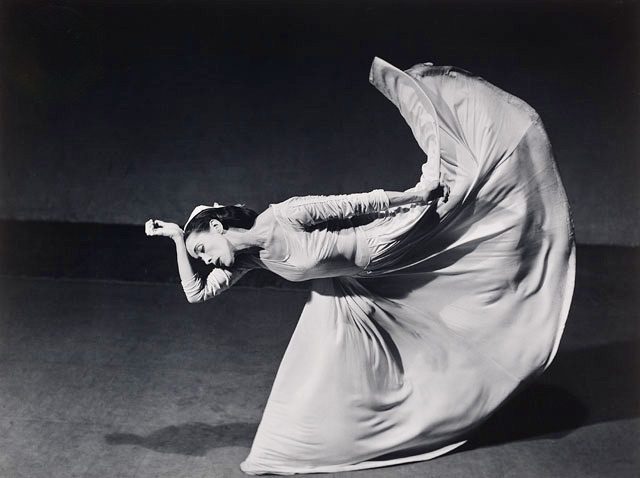
With Graham, it was different. Where ballet had an inherent gracefulness, refined and elegant, lyrical and delicate, Graham’s technique expressed a severity and weightiness that understood the human condition through the force of gravity. That’s not to say that her choreography did not soar at times because it did, but an earthbound quality was even evident in her dancers. They seemed stronger, thicker, and more muscular than the ballerinas and boys I had seen across town. The difference was most likely a result of all the floor work in Graham technique, the constant contractions, and releases and spiraling through the pelvis and torso, falling and rising and falling again.
I noticed something else while seated at the piano that I intuited as a child and grew to deeply understand as I got older, especially while studying music at college. Now I see it applied right in front of me. Music, when performed, existed in time: the duration of sounds, silences, tempos, and dynamics that spanned seconds and minutes or hours. Dance, however, lived in both space and time. It was different. At that moment, it was more complete, a perfect art form.
“Let’s try this again,” Sussman told me, “But this time, I want you to be more deliberate in your playing. Connect with the dancers and mean it.”
The dancers scrambled off the floor and took their positions as one of them counted off, setting the tempo. I caught the upbeat with a dissonant glissando; by the downbeat, energy and purpose I hadn’t experienced during my first run became evident. By the end of the sequence, I felt a mental and physical release.
As each of us took turns at the piano, Sussman delivered insights, inspirations, and examples to follow and execute. We softened as we learned, no longer driven by egos that nagged us to show off in front of each other. Instead, we learned to give more, support the dancers, and function as improvisational accompanists with the creative freedom to experiment with and explore possibilities through sound, but always in service to the dancers. Sussman encouraged us to be playful, to not rely solely on our hands and fingers to produce our music. I soon began employing my forearms and elbows to create percussive soundscapes corresponding to the dancers’ actions and feelings. Occasionally, I would even reach into the piano to pluck, strum, or scrape my nails across strings reminiscent of Henry Cowell’s Banshee or a work by Ligeti, Cage, or Crumb.
When we were afforded a break from our training and to find shelter from the August heat and humidity that always seemed to fill the second-floor dance studio we worked in, the three of us would take seats on two opposing benches wedged across from each other in a small vestibule that led into to the main studio on the first floor. We chatted and sipped Cokes and iced tea, sharing personal stories and professional dreams. On one such occasion, an abrupt silence came over us as new energy invaded our small space. We grew silent in the sudden shift, and all stood for no apparent reason when the swinging doors that led to the studio swung open, and there she was: the diva of modern dance herself. Sussman and dancer Bertram Ross flanked Martha Graham, who seemed to float just above the ground in a black Halston dress. She looked mystical as she levitated before us, an aura of otherworldliness surrounding her. She also reminded me of an art teacher I taught with in Toms River who also could levitate. Rather than wearing Halston, which she could never afford, she opted for oversized, floral-print moo-moos to conceal her somewhat large form. The same shaped garment every day, only the colors and prints would change. I think she sewed them herself. I privately referred to her as Floating Bobbi because I could never see her feet or see them move as she made her way through the hallways. She seemed to hover over the floor like some overripe fairy as she glided from classroom to classroom, towing her magical art cart behind her.
Sussman introduced us to Graham, who acknowledged us with a practiced nod. I noticed her hands, gnarled with her thumbs pinched into the tips of her fingers from debilitating arthritis but resembling how I often saw her dancers hold theirs during class, especially during floor-work contractions. I wondered whether they were empathetic toward Graham and her condition or if Graham’s disfigurement somehow influenced her technique for others to mimic.
During the third week of the training, Christine Wengerd, the administrative director for the Martha Graham School, asked me if I could stay around for an evening class and fill in for an accompanist who had called in sick. It was my official debut as a dance accompanist and an opportunity to play an entire class from beginning to end and get paid for it. I thought back to the Village Voice ad I answered a few weeks ago and how it promised regular work after the workshop concluded; a bold promise. Was that a guarantee? Yet I was already offered a play class even before the training ended. I also discovered how much I enjoyed this work, using my training as a musician to be of use and work collaboratively with others.
A day later, Christine sent me to the Alvin Ailey American Dance Theater just a few blocks away at 229 East 59th Street to play a class when an accompanist didn’t show. I was hooked after that and began playing classes on Saturdays at Graham’s, working with Graham dancer Daniel Maloney. He then recommended me to another choreographer, Mary Anthony, where I also began playing at her studio at 736 Broadway.
Most Saturdays, I’d be done by 1:00 p.m. unless I stayed for a dance class at Graham’s. I thought it would help my playing if I knew what it felt like to experience Graham’s technique. Easier said than done. The floor work alone was the most brutal physical workout I’ve ever endured. But I was okay with how Graham’s technique embraced gravity, unlike ballet, where you tried to defy it.
I liked gravity and feared heights, so I was fine for most of the class since we spent so much time writhing on the floor, contracting and releasing in time to the harsh percussive sounds of the piano. I was exhausted when we transitioned to the next class segment. But there was no escaping what came next: the across-the-floor sequences. I was in self-conscious trouble that I couldn’t dance away. Traveling across the floor doing long running strides, leaps, jetés, and pirouettes scared me shitless. I was embarrassed by how my body moved through space. Something as natural as keeping my arms and legs in opposition as I moved across the room became a struggle. Every movement had to be worked out in my head before executing it; that delay in messaging the steps from the brain to body made me look like I was dancing to the beat of a completely different drummer. The awkward proof of my lubberly movement was reflected in every mirrored surface in the studio. But my struggle in dancing Graham helped me better appreciate what dancers go through to learn their craft. The empathetic understanding I gained by taking a class now and then allowed me to become a better accompanist and better aid the dancers. They sometimes appeared to be physically suffering for their art.
And once the class had ended and the endorphins had kicked in, I’d dash out into the city and skip across town to my favorite place, Great Aunt Fanny’s on West 46th Street. I’d down two beers and a Fanny burger in quick succession. Then, on most Saturdays, after my unholy communion and confessing my week’s sins to the bartender, I’d sneak into the second half of a Broadway matinee right after intermission joining the crowd as they returned to their seats. It was easy to find an empty seat; someone at Fanny’s told me how to do it. No one cared if you had a ticket and the ushers huddled together in darkened corners, their work done for that performance. So during a couple of seasons, I knew how every show on the Great White Way ended but not how they began.
One Saturday, months after training at Graham’s and now working as a legitimate dance accompanist, I walked along Seventh Avenue just down from Times Square on my way to Penn Station to catch the Jersey Coast Line back to Bay Head. It was raining just like the day last August when I answered that Village Voice ad was looking for piano players: a gentle rain where the sun shone through thin clouds as its rays danced through the drops splashing prismed light in my eyes like a spinning mirrored disco ball.
“Psst… Hey, do you want a blow job?”
I looked in the direction where the voice had come from and noticed a familiar face in a shadowed doorway; well, as familiar as a face could be after seeing it only once in what seemed like less than a New York minute seven months earlier. But this time, I didn’t even have to respond as the woman came out from the safety of her hidey-hole.
“Oh, it’s you… Jersey boy! I remember you. How’s it going?” She remembered me.
She stood before me in stretchy purple leggings, a too-tight neon yellow sweater, and a malnourished feathery boa wrapped around her neck that somehow paired nicely with her super-extended eyelashes. “Dress for success,” I thought, wondering if her lashes got in the way during sex.
And I told her what I was up to, and she told me what she was up to, even though I already knew, then made my way to the train. So I felt a connection to this city I hadn’t felt before; I knew people here and then tunneled my way back to New Jersey.